Heat stress prevention is the single most important summer safety responsibility for employers in physically demanding industries. It is also among the most preventable workplace hazards in the U.S. According to OSHA, almost half of heat-related fatalities occur on a person’s first day on the job, and more than 70% occur during their first week. That’s not a weather problem. It’s a management problem.
OSHA agrees. In April 2026, the agency renewed its National Emphasis Program (NEP) for Heat-Related Hazards, a five-year enforcement directive built on a simple premise: heat illness is preventable, and employers who aren't preventing it will be found.
The stakes for employers are real. An OSHA citation for a heat-related violation goes on your enforcement record. Fines can reach thousands of dollars per violation, and willful or repeat offenses carry even higher penalties. Beyond regulatory exposure, a serious heat illness incident can trigger workers' comp claims, lost productivity, and lasting workforce trust issues.
Now that you understand what’s at stake, it’s time to take control of heat safety in your workplace.
What Is Heat Stress?
Heat stress is what happens when the body absorbs more heat than it can release.
Your body is constantly generating heat through physical activity and absorbing it from the surrounding environment. Under normal conditions, sweating handles the difference—sweat evaporates from the skin and carries excess heat away. When temperature and humidity climb, that process slows. The body can't shed heat fast enough, and core temperature starts to rise.
It's not an illness itself. It's the condition that leads to illness if no one intervenes. That distinction matters because employers can act at the heat stress stage, before a worker becomes a patient.
The earlier you catch it, the easier it is to address. A worker who feels dizzy and is moved to a cool area is recoverable in minutes. A worker experiencing heat stroke requires emergency care and may suffer permanent consequences.
How Heat Stress Happens
Heat stress isn't just about air temperature. Multiple factors combine to determine how much strain the body is under at any given moment, and some of the most dangerous conditions don't feel extreme until it's too late.
Environmental Contributors
A calm, overcast day at 90°F is a very different physiological experience than 88°F in direct sun with 80% humidity and no breeze. The factors that matter most:
- Ambient air temperature and humidity: High humidity blocks sweat from evaporating, which is the body's primary cooling mechanism.
- Radiant heat from surfaces like asphalt or metal: Pushes the actual heat load on a worker well above what the air temperature suggests.
- Direct sun exposure: Adds radiant heat on top of ambient temperature. A worker in full sun can experience conditions 10–15°F hotter than the thermometer reads.
- Lack of airflow: Removes the wind-chill effect that helps sweat evaporate. Enclosed spaces, building interiors, and calm weather days all reduce the body's ability to cool.
Work-Related Contributors
The work itself matters as much as the weather. Two workers in the same environment can face very different heat loads depending on what they're doing:
- Physical exertion: Generates internal body heat on top of environmental heat. Heavy lifting, digging, or carrying loads in the heat multiplies the risk significantly.
- Personal Protective Equipment (PPE): Protective suits, respirators, and multi-layer gear trap body heat that would otherwise dissipate. Workers in full PPE can reach dangerous heat loads even on moderately warm days.
- Duration of exposure: A worker who has been outside for six hours is in a different physiological state than one who started an hour ago.
- Moving between hot and cooler environments: Moving from an air-conditioned break room back to a hot job site repeatedly can mask how heat is accumulating in the body.
Measuring Heat Risk: Heat Index vs. WBGT
Knowing it's hot outside isn't enough. To make good decisions about work schedules, break frequency, and when to pull workers from the heat, you need a way to measure the actual heat load on the body. Two tools do that job.
The heat index combines air temperature and relative humidity to estimate how the heat feels at rest. It's calculated from standard weather data and is available through the free OSHA-NIOSH Heat Safety Tool app. For most employers, this is the right place to start.
Wet Bulb Globe Temperature (WBGT) goes further. It factors in temperature, humidity, radiant heat, and wind speed, giving a more accurate picture of the heat load on a body that's actually working, not just standing still. OSHA recommends WBGT for high-risk assessments, particularly in environments with strong radiant heat sources, such as direct sunlight, metal roofing, or industrial equipment.
For most small and mid-sized employers, the heat index covers daily decision-making. If your workers experience environmental and work-related factors that contribute to heat, a WBGT meter gives you a more defensible reading. The OSHA-NIOSH Heat Safety Tool app supports both measurements and translates the result into recommended work/rest ratios.
Who Is Most at Risk for Heat Stress?
Heat stress can affect anyone working in a hot environment. But risk is not evenly distributed.
Industries with Elevated Exposure
Environments that combine physical exertion, limited climate control, and prolonged exposure to outdoor or indoor heat have a higher risk profile.
- Construction and Skilled Trades
- Agriculture
- Manufacturing
- Warehousing
- Landscaping
- Roofing
- Oil and Gas
- Foundries
- Commercial Kitchens
Worker-Level Risk Factors
Individual factors also matter. It’s not enough to broadly consider the risk profile of your industry or business, but you also need to factor in your unique workforce.
- New and returning workers who haven’t yet built heat tolerance
- Older workers, whose bodies regulate temperature less efficiently
- Workers with cardiovascular or kidney conditions, which affect the body’s cooling capacity
- Workers on certain medications, including diuretics, antihistamines, and some antidepressants, which can impair sweating or increase core temperature
How to Spot Heat-Related Illness
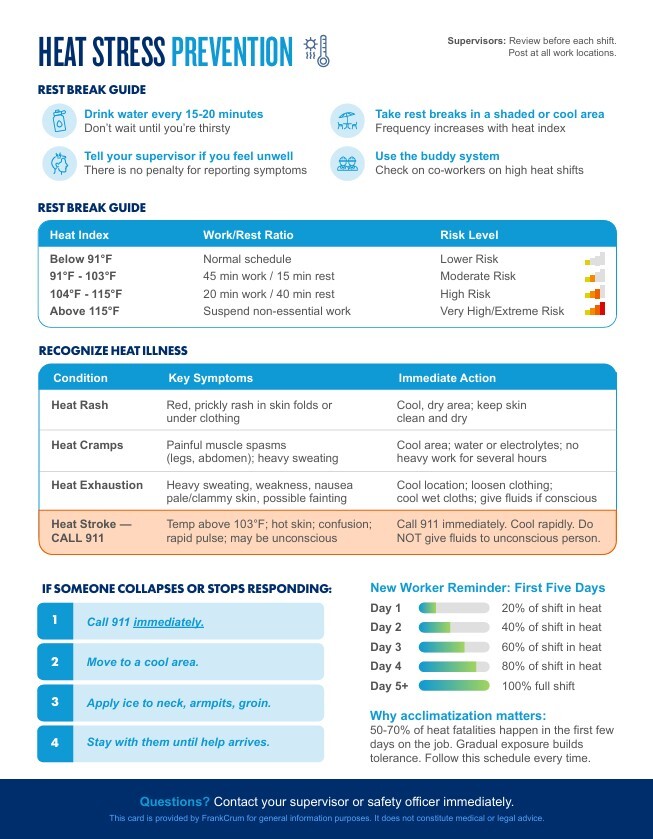
Heat-related illness progresses along a spectrum. The earlier a supervisor or coworker recognizes symptoms, the easier the intervention. The table below summarizes each condition, its key symptoms, and the required response.
Heat Rash
Heat rash develops when sweat ducts become blocked, and sweat can’t reach the skin’s surface. It appears as small red bumps or blisters in skin folds or areas where clothing fits tightly. Move the worker to a dry, cool area. If workers are developing heat rash regularly, it signals the work environment needs better ventilation or cooling.
Heat Cramps
Heat cramps are painful muscle spasms caused by heavy sweating combined with inadequate fluid and electrolyte intake. They typically affect the legs, arms, or abdomen. Rest in a cool area and replace fluids—water for mild cases, electrolyte drinks when sweating has been heavy. Don’t return the worker to strenuous activity for several hours after cramps resolve.
Heat Exhaustion
Heat exhaustion is a more serious condition caused by dehydration and salt loss. A worker may feel weak and nauseated, may vomit, and may have pale, clammy skin. Get the worker to a cool location, loosen clothing, and apply cool wet cloths. If conscious and not vomiting, provide water. Monitor closely, as heat exhaustion can quickly escalate to heat stroke.
Heat Stroke
Heat stroke is a medical emergency. When core temperature rises above 103°F, the worker may become confused, exhibit slurred speech, or lose consciousness. Skin may be hot and dry or hot and wet. Call 911 immediately. Cool the worker as rapidly as possible. Apply ice packs to the neck, armpits, and groin, or cold-water immersion if available. Do not give fluids to an unconscious person.
How to Prevent Heat Stress at Work
Workplace Heat Stress Prevention Kit
Download the Workplace Heat Stress Prevention Kit to get practical tools for protecting your crew during hot weather, including a customizable prevention checklist and a ready-to-post worksite flyer.
Inside, you'll find guidance on heat stress basics, work/rest schedules based on the heat index, emergency response planning, and how to safely acclimate new workers to hot conditions—everything you need to build a safer workplace and reduce future claims.
We respect your privacy.
Effective heat stress prevention comes down to four things working together: acclimatizing workers, monitoring conditions, adjusting the work, and cooling the environment. The most important of these, by a wide margin, is acclimatization.
Start with Acclimatization
Even though most employers know that heat-related fatalities typically happen in the first few days on the job, few have formal acclimatization schedules in place.
Acclimatization is the physiological process by which the body adapts to heat exposure over time. Sweat rate increases, sweat begins earlier, heart rate during exertion decreases, and the body becomes more efficient at cooling. This process takes 7–14 days of progressive heat exposure to complete.
For new workers, OSHA and NIOSH recommend the “Rule of 20 Percent” to standardize the acclimatization process:
- Day one: Limit heat exposure to 20% of a normal shift.
- Each additional day: Increase exposure by 20% until the worker is on a full schedule by the end of the first week.
For returning workers who have been away for a week or more, use a compressed ramp, typically reaching full exposure over 4 days.
Track it. Supervisors should know which workers are still in their acclimatization window and adjust assignments accordingly.
Monitor Conditions Daily
A heat illness prevention plan that doesn't account for what the weather is actually doing on a given day isn't a plan; it's a formality. Conditions change, and your protocols need to change with them. Before work starts each morning, know what you're dealing with.
- Check the heat index every morning. The free OSHA-NIOSH Heat Safety Tool app translates conditions into recommended work/rest ratios and action levels.
- For environments with radiant heat, limited airflow, or heavy PPE, use a WBGT meter for a more accurate assessment.
- Tie daily decisions, such as break frequency, shift timing, and task assignments, to those readings, not a fixed schedule.
Adjust the Work
You can't move the sun or turn down the temperature, but you control the schedule, the pace, and how work gets done. Those levers matter more than most employers realize.
- Schedule the most physically demanding tasks for early morning or late afternoon.
- Increase rest break frequency as the heat index rises, and take breaks in shaded or cooled areas, not on the asphalt next to equipment.
- Build hydration into the routine. Provide water and electrolyte drinks at all times. OSHA’s general guidance is approximately one cup of water every 15–20 minutes during heat exposure. Ice pops are a simple, popular supplement.
- Use a buddy system and have supervisors conduct check-ins throughout the shift.
- Train everyone—workers and supervisors—to recognize symptoms and respond to emergencies.
Cool the Environment
Not every worksite allows for full climate control, but most allow for something. Start with what's available and layer in additional controls as conditions or budget permits.
- Air conditioning or evaporative cooling in rest areas
- Industrial fans to increase airflow on indoor job sites
- Shade structures for outdoor work areas
- Reflective barriers between workers and radiant heat sources
- Cooling stations with cold water and ice for quick recovery
Equip Workers for the Heat
Gear won't substitute for a solid prevention program, but the right equipment gives workers a meaningful edge, particularly in environments where heavy PPE is already adding to their heat load.
- Cooling vests or ice vests
- Cooling towels and neck wraps
- Breathable, lightweight, light-colored clothing
- Hard hat cooling inserts for workers in direct sun
Wearable Monitoring Technology
While cooling gear reduces heat load, wearable monitoring technology does something different. It tells you when a specific worker’s body is approaching a dangerous threshold before they show visible symptoms.
A growing category of industrial wearables now tracks core body temperature, heart rate, and exertion level in real time, sending alerts to both the worker and their supervisor when physiological stress crosses a defined limit. By the time a worker looks or feels unwell, heat stress is often already advanced. These devices shift the response from reactive to proactive.
There are two noteworthy platforms gaining traction in construction and physically demanding industries. SlateSafety’s BAND V2 is an arm-worn device that monitors core temperature, heart rate, and exertion level while integrating with a cloud dashboard that gives supervisors real-time visibility.
VigiLife’s Shield was developed from the U.S. Air Force and Department of Defense research. It pairs physiological tracking with real-time environmental sensing to deliver alerts before heat stress becomes dangerous.
Wearables aren't a replacement for acclimatization schedules, hydration protocols, and adjusted work schedules. They're a layer on top of them, and for employers managing large crews across job sites, a meaningful evolution in how heat safety gets monitored in real time.
Heat Safety Regulations
OSHA's Renewed Heat Enforcement Program
Although there’s no finalized federal heat standard yet, that hasn’t slowed OSHA down. In April 2026, OSHA renewed and significantly strengthened its National Emphasis Program (NEP) for Outdoor and Indoor Heat-Related Hazards. This five-year enforcement directive is meant to scrutinize employers that do not take heat safety seriously and expose their workers to largely preventable heat illness.
The numbers make clear how seriously OSHA is pursuing this. Between 2022 and 2025, OSHA conducted approximately 2,400 heat-related inspections per year, up from roughly 200 per year before the program launched.
The good news is that OSHA isn’t trying to catch employers off guard. The program is transparent. If you're not sure where your business stands, start with the questions most employers ask first.
What triggers an OSHA heat inspection?
When the heat index reaches 80°F, OSHA designates a 'heat priority day.' Inspectors already on site must evaluate heat hazards, and area offices assess worksites in high-risk industries. Programmed inspections are triggered when the National Weather Service issues a heat warning or advisory for the local area. For businesses in Florida, Texas, and other warm-climate states, that means heightened inspection activity year-round.
What industries are OSHA targeting for heat inspections?
OSHA revised its list of 55 industries at higher risk of heat-related incidents based on 2021-2024 data. Industries include:
- Construction (roofing, masonry, general contracting)
- Landscaping and groundskeeping
- Agriculture
- Restaurants and food service
- Retail warehousing and stocking
- Manufacturing and bakeries
It’s important to note that even if your industry isn’t on the targeted list, OSHA can still inspect your workplace if a heat hazard is visible, or if a complaint, referral, or injury report is filed.
What will an inspector look for in a heat-related inspection?
OSHA added a structured evaluation framework to the renewed NEP that functions as a compliance checklist. If an inspector shows up, these are the six things they'll be looking for:
- Cool, potable drinking water readily accessible to all employees
- Rest breaks and shade (or cool rest areas for indoor workers)
- An acclimatization plan for new or returning employees covering the first 7–14 days
- A system for monitoring heat conditions and work exertion levels
- Training for employees and supervisors on recognizing and responding to heat illness
- A written emergency response plan for heat stroke and heat exhaustion
What are the consequences for a heat-related OSHA violation?
Violations result in citations, fines, and hazard alert letters that become part of your enforcement record. Employers newly added to the targeted list receive a mandatory 90-day outreach period before programmed inspections begin. Use that window to build your program.
State Heat Standards
OSHA currently reports that five states have enforceable heat illness prevention standards. Maryland and Nevada have also published statewide standards, bringing the total to seven states authoring their own heat rules. If you operate in any of these states, you’re already subject to enforceable requirements.
If you operate across multiple states, your compliance obligations may differ significantly by location. Check with your HR advisor or your state’s labor department to confirm what applies to your workforce.
Review your heat illness prevention plan yearly, before the start of hot season, and after any serious heat-related incident.
How FrankCrum Supports Workplace Heat Safety
Building a heat illness prevention program is straightforward in principle. Executing it consistently, across job sites, seasonal workers, new hires, and changing weather, is where most small and mid-sized businesses run into problems.
FrankCrum’s workers’ compensation and risk management services include loss control support, safety program development, and dedicated safety specialists who work directly with clients to reduce the conditions that lead to claims. That means helping you build the kind of acclimatization tracking, monitoring protocols, and supervisor training that keeps workers safe before an incident happens, not just managing paperwork after one does.
Heat illness is among the most preventable categories of workplace injury. The right safety program doesn’t require a large budget; it requires structure, consistency, and follow-through. We can help.