
Pay-as-you-go workers' comp is a billing method that calculates your premium based on actual payroll each pay period rather than an annual estimate. If you've ever opened a year-end audit bill you weren't expecting, you already understand the problem it solves.
Employers typically look into this option for a few reasons: the size of the upfront payment traditional billing requires, its effect on cash flow, a workforce that changes throughout the year, or a history of large year-end audit adjustments. The guide below covers how it works, how it compares to traditional billing, and where it tends to fit best.
How Does Pay-As-You-Go Workers' Comp Work?
Pay-as-you-go workers' comp works by calculating your premium from the payroll you actually process each pay period, then collecting it with or around that payroll cycle.
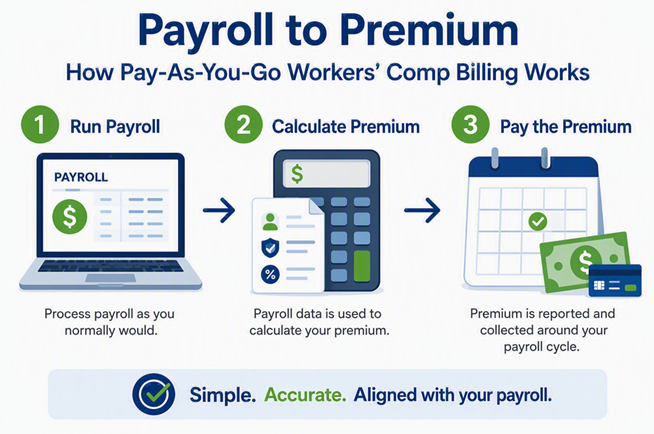
Here's the general sequence most pay-as-you-go programs follow:
- You process payroll for the current pay period, as you normally would
- Current payroll amounts, employee classifications (codes that categorize each job's duties for rating purposes), and applicable rates are used to calculate that period's premium
- The premium is reported, deducted, or collected around your payroll cycle
It’s important to remember that the accuracy of this billing method still relies on correct payroll and classification data. You and your provider still need complete, correctly coded payroll information for the calculation to reflect reality.
Pay-As-You-Go vs. Traditional Workers' Comp Billing
Pay-as-you-go and traditional workers’ comp provide the same coverage, and either one will satisfy a legal obligation to carry workers’ comp.
The core differences include what the premium is based on and the timing of payments. Traditional billing estimates your annual payroll upfront, and bills it as a lump sum plus installments; pay-as-you-go calculates your premium based on payroll reported each pay period. Exact terms vary by carrier, provider, policy, and state, so confirm the specifics of any program you're considering.
5 Benefits of Pay-As-You-Go Workers' Comp
With pay-as-you-go billing, workers' comp premiums are calculated based on actual payroll each pay cycle rather than an annual estimate. That single shift removes many of the pain points employers associate with traditional workers’ comp policies. These are the main benefits employers typically see with pay-as-you-go billing.
1. Avoid Large Upfront Workers' Comp Deposits
With a traditional guaranteed-cost policy (one priced off an annual estimate), the carrier doesn't find out what you actually owed until the year-end audit. That means they cover you for a full year before knowing whether your payroll matched their estimate.
The deposit is essentially collateral against that gap.
Pay-as-you-go changes that math, not just the schedule. When your premium is calculated from actual payroll each pay period, the provider is never more than one pay cycle behind what it's collected relative to the exposure it's covering. There's no year-long estimate to hedge against, so there's far less need for a large cash cushion upfront.
Pay-as-you-go may reduce or eliminate the need for a deposit, freeing up working capital for payroll, equipment, inventory, or other operating costs right when you need it. But there are circumstances, such as a new business with no payroll history, that may still require upfront cash.
It’s important to remember: you're changing when you pay, not avoiding the premium. A lower upfront cost isn't a lower total cost, and not every program eliminates the deposit entirely; terms vary by provider.
2. Align Premium Payments with Actual Payroll, Not Estimates
With traditional billing, your annual estimate gets locked in before the policy year starts, usually based on last year's payroll or a rough forecast. That number stays fixed for the rest of the year while your actual payroll keeps moving, so the longer the policy runs, the more room there is for reality to shift away from the starting guess.
If your real payroll ends up higher than the estimate (growth, added headcount, wage increases), you were paying a premium against a smaller number all year, and you owe the difference at the audit. If it ends up lower (layoffs, a slower season than expected), the opposite happens: you overpaid relative to a higher number than reality, and you're due a refund.
Pay-as-you-go avoids this because each payment is recalculated based on what you actually reported that cycle, so there's no months-long stretch where the premium rides on a guess rather than your real numbers.
3. Improve Cash-Flow Predictability
Spreading premium payments across your normal payroll cycles, instead of paying one large sum, makes workers' comp a more predictable line item you can actually plan for.
Predictability here doesn't mean identical payments every cycle; it means no large, disconnected surprise waiting for you at year's end. Traditional billing concentrates its uncertainty into one moment, the audit, where a mismatch between your stale annual estimate and your real payroll builds up quietly all year and then lands as one lump reconciliation bill.
Pay-as-you-go spreads that same uncertainty out instead of storing it up. Each payment is tied to a payroll number you already know and are already budgeting for, so if payroll drops in a slow month, your premium drops with it in that same cycle instead of staying fixed at a rate based on a different assumption.
4. Adjust Workers' Comp Payments as Your Workforce Changes
When your premium is based on current payroll, it adjusts with your workforce rather than staying locked into a months-old projection. That's especially relevant for:
- Seasonal businesses that add staff during peak periods and scale back afterward
- Contractors whose crew size and payroll shift as projects start, ramp up, slow down, or wrap up
- Businesses going through rapid hiring, layoffs, reduced hours, or significant overtime changes
A lower payroll period generally means a lower premium payment, and a higher one means a higher payment, subject to your classifications, rates, and program terms.
According to NCCI's 2026 State of the Line report, payroll (the base used to calculate workers' comp premiums) grew roughly 5% in 2025, driven almost entirely by wage increases rather than employment gains. For any employer whose payroll moves, that's a reminder that a premium tied to a single annual estimate can shift further from reality the longer the policy runs.
5. Simplify and Better Manage Year-End Workers' Comp Audits
Reporting payroll throughout the year, rather than once at renewal, narrows the gap between estimated and actual payroll that must be reconciled at audit time, generally resulting in a more manageable audit and a lower risk of an unexpected adjustment.
The audit exists to catch gaps that have built up between your estimate and reality, and traditionally, it’s only checked at year's end. Every month of drift between what was estimated and what actually happened accumulates, so the auditor has a full year of ground to reconstruct.
Reporting payroll every cycle removes that year-long buildup. Because premium is already recalculated from real numbers each period, there's rarely a large discrepancy left for the audit to uncover, so what's left to check is mostly qualitative, confirming classifications and subcontractor status, rather than reconciling a year's worth of accumulated financial drift.
Payroll integration, where available, can also cut manual reporting and duplicate entries. Audits may still verify payroll, classifications, and subcontractor information, so accurate class codes still matter. Pay-as-you-go doesn't eliminate audits for every provider; some, like FrankCrum, offer no year-end audits as a specific feature, covered later in this guide.
Is Pay-As-You-Go Workers' Comp Cheaper Than Traditional Workers' Comp?
Not necessarily. Pay-as-you-go may require less money upfront and improve cash-flow timing, but it doesn't automatically lower your rate or total annual premium.
Your total cost still depends on the same underlying factors regardless of billing method:
- Your payroll amount and how it changes over the year
- Employee classifications and the risk level of the work performed
- Your industry, location, claims history, and experience modification factor (a number that adjusts your premium based on past claims versus similar businesses)
- Carrier terms and any program or processing fees
- Discounts or fees tied to annual, installment, or pay-as-you-go billing specifically
Bottom line: pay-as-you-go may be cheaper upfront without being cheaper overall, and it's worth evaluating both factors separately.
Is Pay-As-You-Go Workers' Comp a Good Fit for Your Business?
It depends on your payroll patterns, cash-flow priorities, available integrations, program fees, and the provider itself. There's no universal answer, but the checklist below is a starting point.
Pay-as-you-go may be worth considering if:
- Your payroll changes noticeably throughout the year
- You hire seasonal or temporary workers
- Your workforce shifts from one project or phase to another, as with many contracting businesses
- Avoiding a large upfront payment or preserving cash flow is a priority
- You've dealt with significant premium adjustments tied to payroll estimates in the past
- You want workers' comp premium reporting coordinated with your payroll process
Stable payroll, added fees, limited carrier availability, or a lack of payroll integration can all affect whether the switch is worth it. It's as much a fit question as a cost question.
What Are the Benefits of Using a PEO for Pay-As-You-Go Workers' Comp?
A professional employer organization, or PEO, is a company that enters a co-employment relationship to handle HR functions like payroll, benefits, and workers' comp for its clients.
More than 230,000 U.S. businesses currently partner with a PEO, representing about 15 percent of all employers with 10 to 499 employees, according to NAPEO's October 2025 research on PEO clients.
Its main advantage here is coordinating payroll and workers' comp premium reporting under a single relationship rather than with two separate providers.
Depending on the PEO and your service agreement, that single relationship may also cover:
- Employee and classification information, kept consistent across payroll and workers' comp
- Claims, safety, risk management, or HR and compliance questions
- Responsibilities that would otherwise route through several separate contacts
PEO programs differ meaningfully. Not every PEO owns its own workers’ comp carrier, eliminates deposits or audits, or offers the same level of support, so ask specifically how a given PEO's program is structured.
With that said, the cost of workers’ comp is one of the most common reasons small employers explore PEOs.
Pay-As-You-Go Workers' Comp Through FrankCrum
Workers' compensation is part of FrankCrum's broader PEO solution, so payroll, premium calculations, and risk support work together instead of running through separate vendors, the practical payoff of pairing pay-as-you-go billing with a PEO relationship.
Because we own our insurance carrier, rather than brokering through a third party, we control coverage, claims, and pricing directly, which is why no down payment and no year-end audit are standard here.
Through our affiliated, AM Best-rated carrier, Frank Winston Crum Insurance, FrankCrum PEO clients get:
- No down payment to start coverage
- Premium payments based on actual payroll, calculated with your regular payroll cycle
- No year-end audits
- Support from a dedicated claims and service team that knows your business, not a call center
- Risk-management and workplace-safety guidance to help reduce claims before they happen
- 24/7 access to certificates of insurance through MyFrankCrum, our HR technology platform
Frequently Asked Questions
Is pay-as-you-go workers' comp a different type of insurance?
No. Pay-as-you-go is a billing method, not a separate insurance product. It changes how your premium is calculated and paid, using actual payroll instead of an estimate, but your coverage, state requirements, and responsibility to carry a valid policy stay the same.
Does pay-as-you-go workers' comp eliminate the need for an audit?
Not automatically. Reporting payroll throughout the year typically shrinks the gap reconciled at audit time. Some providers, including FrankCrum, offer no year-end audits as a specific feature, but that varies, so confirm directly.
How is my premium calculated with pay-as-you-go billing?
Your premium is calculated based on actual payroll for each pay period, using your employee classifications and the applicable workers' comp rates. Those are the same variables that drive a traditional premium; pay-as-you-go just changes how often the calculation runs.
Can pay-as-you-go workers' comp work with any payroll provider?
It depends on the provider. Some pay-as-you-go solutions integrate directly with specific payroll systems and automate reporting, while others require manual submission. Ask any provider you're evaluating which payroll systems their program supports.
Are there extra fees for pay-as-you-go workers' comp billing?
Some providers charge setup or per-payroll processing fees, while others build the billing method into the standard premium. Fee structures vary by carrier and provider, so ask directly rather than assuming pay-as-you-go is automatically free or cheaper.
Is pay-as-you-go workers' comp available in every state?
Availability depends on the carrier and program, though workers' comp requirements themselves vary by state. Some states have monopolistic systems that limit which carriers can write coverage, so confirm availability for your state with any provider you're considering.