
Workplace safety is the ongoing practice of finding and controlling hazards before they cause work-related injuries and illnesses. It is based on a hazard control process: a loop of looking, fixing, and checking again, supported by clear management procedures, training, and employee involvement.
Workplace safety often becomes a priority only after something goes wrong, like a slip in the kitchen, a fall from a ladder, or a near miss. The best time to act is early, by spotting and fixing hazards when costs are low.
There’s no “one-size-fits-all” approach or magic checklist to follow, as each workplace—from offices to construction sites—encounters unique risks. But the principle of workplace safety remains the same: proactively spot and remove hazards before someone gets hurt.
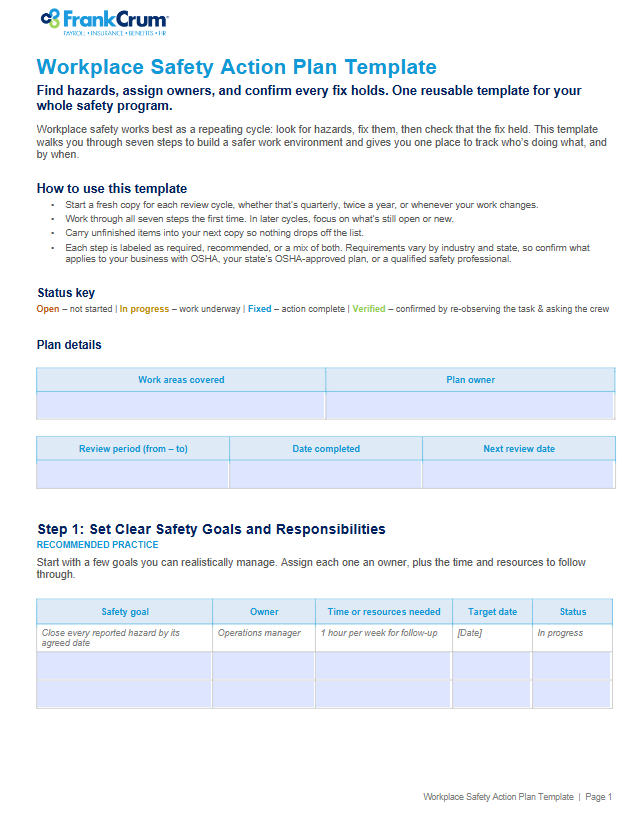
This article covers what workplace safety is, who's responsible, how to spot hazards, and seven steps to build a safer work environment, with a template to track the work.
What Is Workplace Safety?
Workplace safety is a proactive approach to preventing accidents and illnesses on the job. Most employers know that safety matters, but it takes effort to turn good intentions into action.
Achieving workplace safety requires more than a poster, a policy binder, or a single training day. It's a loop of looking, fixing, and checking again.
It requires consistent, standardized practices to identify hazards, control risks, and establish safe ways of working.
And the effort to maintain safety standards never ends. Equipment wears, work changes, and new people join, so a hazard that wasn't there last spring can appear this fall.
Before getting into who handles that work, it helps to see what's at stake.
Why Is Workplace Safety Important?
While workplace injuries, illnesses, and deaths have been on a downward trajectory in recent years, they remain common and costly. The National Safety Council (NSC), a nonprofit safety organization, counted 4,337 preventable work deaths in 2024, along with an estimated 3.95 million medically consulted injuries (injuries that led people to seek medical care) and $181.4 billion in costs.
Work-related incidents are a matter of “when,” not “if.” In addition to preventing injuries and illness, strong safety programs also help to:
- Support compliance requirements
- Reduce injury-related costs and downtime
- Keep employees engaged and productive
- Lower workers’ compensation premiums
With the stakes clear, the next question is who owns the work.
Who Is Responsible for Workplace Safety?
Everyone plays a part, but employers carry the legal duty. Under the Occupational Safety and Health Act (OSH Act), employers are responsible for furnishing a workplace free from hazards likely to cause death or serious harm. OSHA's employer guidance also states that safety training must be in a language and vocabulary that workers understand.
Responsibilities are divided roughly like this:
- Employers identify hazards, address risks, and provide equipment, training, and safety procedures.
- Managers and supervisors reinforce procedures, respond to reported hazards, and follow up on corrective actions.
- Employees follow procedures, use equipment correctly, and report hazards, injuries, and near misses (i.e., events that could have caused harm but didn't).
How to Identify Workplace Safety Hazards
Employers identify hazards by systematically examining work areas and equipment, watching how tasks are actually performed, and asking employees what inspections miss.
Employees are often fully aware of risks that a walkthrough won’t identify, such as a difficult lifting task or equipment that fails only now and then.
The most common hazards encountered include spills, clutter, blocked exits, unsafe equipment use, and heavy lifting. Repetitive strain deserves special attention also.
Bureau of Labor Statistics (BLS) reports that overexertion, repetitive motion, and bodily conditions caused the most injury cases involving days away, restricted duty, or job transfer in 2023 and 2024. Reinforcing why lifting tasks and workstation setup belong on every hazard walkthrough.
Hazards also differ by workplace.
Begin with a Safety Culture & Program Assessment
An effective safety program begins with an honest self-review of management’s commitment to safety and how consistently employees apply existing safety policies and procedures in their daily work.
This assessment evaluates whether leadership actively supports safety through communication, accountability, training, and resource allocation, while determining whether employees understand, follow, and embrace established safety practices.
By identifying gaps between written procedures and actual workplace behaviors, an organization can recognize what is working, address areas requiring improvement, and develop targeted strategies to strengthen its existing safety culture. The goal is not simply to establish new rules, but to ensure that current safety processes are supported by management, understood by employees, and consistently applied throughout the organization.
How to Build a Safer Work Environment
Seven steps turn hazard-spotting into action. Each one covers what to do, who to involve, and whether it's required or recommended. Requirements vary by industry and state, so confirm what applies to your business with OSHA, your state's OSHA-approved plan (some states, territories, and government entities run their own programs), or a qualified safety professional.
1. Set Clear Safety Goals and Responsibilities
(Recommended practice.)
- Start with a few manageable goals, such as closing reported hazards by an agreed date, and name an owner for each.
- Give owners the time and resources to follow through.
- Involve a manager for each work area and at least one employee who does the work.
2. Address Hazards Before They Cause Injuries
(Recommended practice, though specific hazards have required standards.)
- OSHA's guidance recommends regular inspections and investigating near misses, not only injuries.
- Fix simple hazards on the spot, and rank bigger ones. (OSHA suggests weighing severity, likelihood, and the number of workers exposed, with interim protections until a permanent fix is made).
- Confirm the fix worked by watching the task again and asking the crew, with the supervisor and the workers who do the task involved throughout.
3. Establish Safe Procedures for Everyday Tasks
(Required for some cases, like keeping exits unobstructed, and in some workplaces, like outside construction and agriculture.)
- Write procedures around how work is actually done, covering equipment use, housekeeping, lifting, and always keeping emergency access clear.
- Ask the people who do the work to review the procedures.
- Be sure to avoid copying a universal rulebook; risks are always unique to your industry and work environment.
4. Train Employees and Communicate Safety Expectations
(Required when a standard calls for it; extra training is recommended.)
- Train employees on the hazards associated with their work. (Which training is required depends on the OSHA or state-plan standard that applies, and anything beyond that is your choice).
- Explain changes, invite questions, and check understanding by asking employees to show or explain the task, in a language and vocabulary they understand, with supervisors reinforcing it day to day.
- Remember to document all training to include employee name, date(s) provided, and topic covered. OSHA has to see proof of training, or they won’t consider it as having taken place.
5. Provide Appropriate Safety Equipment
(Required where hazards call for PPE.)
- If personal protective equipment (PPE) like gloves, eye protection, or hearing protection is necessary in your workplace, make sure it matches the hazard and the task at hand.
- Under OSHA's general industry PPE standard, employers must assess hazards, train employees who must use PPE, and generally pay for it, with some exceptions.
- Be sure to ask employees about PPE fit and comfort, show them how to wear and care for it, but skip universal PPE checklists.
6. Involve Employees in Workplace Safety
(Required protection against retaliation.)
- Give employees an easy way to report concerns and offer ideas.
- Follow up on each report and encourage reporting.
- Enforce protections against retaliation to mitigate legal risk, since Section 11(c) of the OSH Act protects employees who raise safety concerns, report injuries, or file complaints.
7. Review and Improve Your Safety Program
(Recommended practice.)
- Make sure to establish a procedure for injury recordkeeping and reporting: OSHA recordkeeping (Form 300 logs, where applicable) and the deadlines for reporting fatalities and serious injuries.
- Track progress against your goals, evaluate results, and return to concerns that are still open.
- Review the program with managers and employees whenever work, equipment, or procedures change, not only on a calendar.
Workplace Safety Planning Kit
Every injury on the job affects your people, your productivity, and your workers’ comp costs. This kit helps you find and fix hazards before they cause harm, then measure whether your safety culture is improving.
We respect your privacy.
How FrankCrum Can Support Workplace Safety
A safer work environment takes steady attention and follow-through, and many small teams don't have the time or in-house expertise. FrankCrum, a professional employer organization (PEO) that shares HR, payroll, and benefits responsibilities with employers, offers safety and risk management support alongside its workers' compensation solution.
That can include on-site reviews, safety management programs tailored to the business, technical resources, loss analysis, and training materials such as recorded webinars and toolbox talks in English and Spanish.
Participating clients can also earn rewards for effective safety management through the Safe Workplace Rewards Program, which reimburses a percentage of their workers' compensation charges based on the program's terms and conditions.
If you’re wondering what this looks like day-to-day, this article explains how workers' comp works through a PEO.
Workplace safety comes down to finding hazards, fixing them, and confirming the fixes hold. Whatever help you use, assign owners and dates, and review the plan as work changes.
Frequently Asked Questions
What are the basic rules of workplace safety?
There's no single national list of basic rules. Common ground includes following safety procedures, using required equipment correctly, reporting hazards and injuries, keeping walkways and exits clear, and getting trained for your tasks. Employers must also follow the OSHA or state-plan standards that apply to their work, which differ by industry.
What are examples of unsafe conditions at work?
Examples include spills and cluttered walkways, blocked exits, damaged or misused equipment, frayed electrical cords, heavy or repetitive lifting, and exposure to dust or chemicals without proper controls. Which conditions matter most depends on the work being done, so review your own environment.
What should employees do if they feel unsafe at work?
Tell a supervisor first, and ask for the hazard to be corrected or for other work.
How can employers encourage employees to report safety concerns?
Make reporting simple, acknowledge every report, and tell people what was done about it. Respond without blame, and never discipline someone for raising a safety concern or reporting an injury, since that can violate anti-retaliation protections. Thank people who speak up so reporting feels worthwhile.
How do employers know which OSHA standards apply to their workplace?
Standards depend on your industry and activities, so start with OSHA's pages for your sector. Also check whether your state runs an OSHA-approved plan: 22 states and territories have plans covering private employers, and they must be at least as effective as federal rules. OSHA's On-site Consultation Program offers free, confidential help to small and medium-sized businesses, separate from inspections, though you agree to fix hazards it identifies.
When should employers review their workplace safety procedures?
Review them on a regular schedule, and also whenever work, equipment, materials, or procedures change, after any injury or near miss, and when employees raise new concerns. OSHA's guidance treats evaluation and improvement as ongoing rather than a one-time check. Set a recurring date, then add reviews for these triggers.


